A ground built for a different league, and kept
The Spartak Stadium in Nalchik was designed for a Soviet city league, not a national top flight. When the Premier League arrived, the ground was already there, and changing it was never seriously on the table.
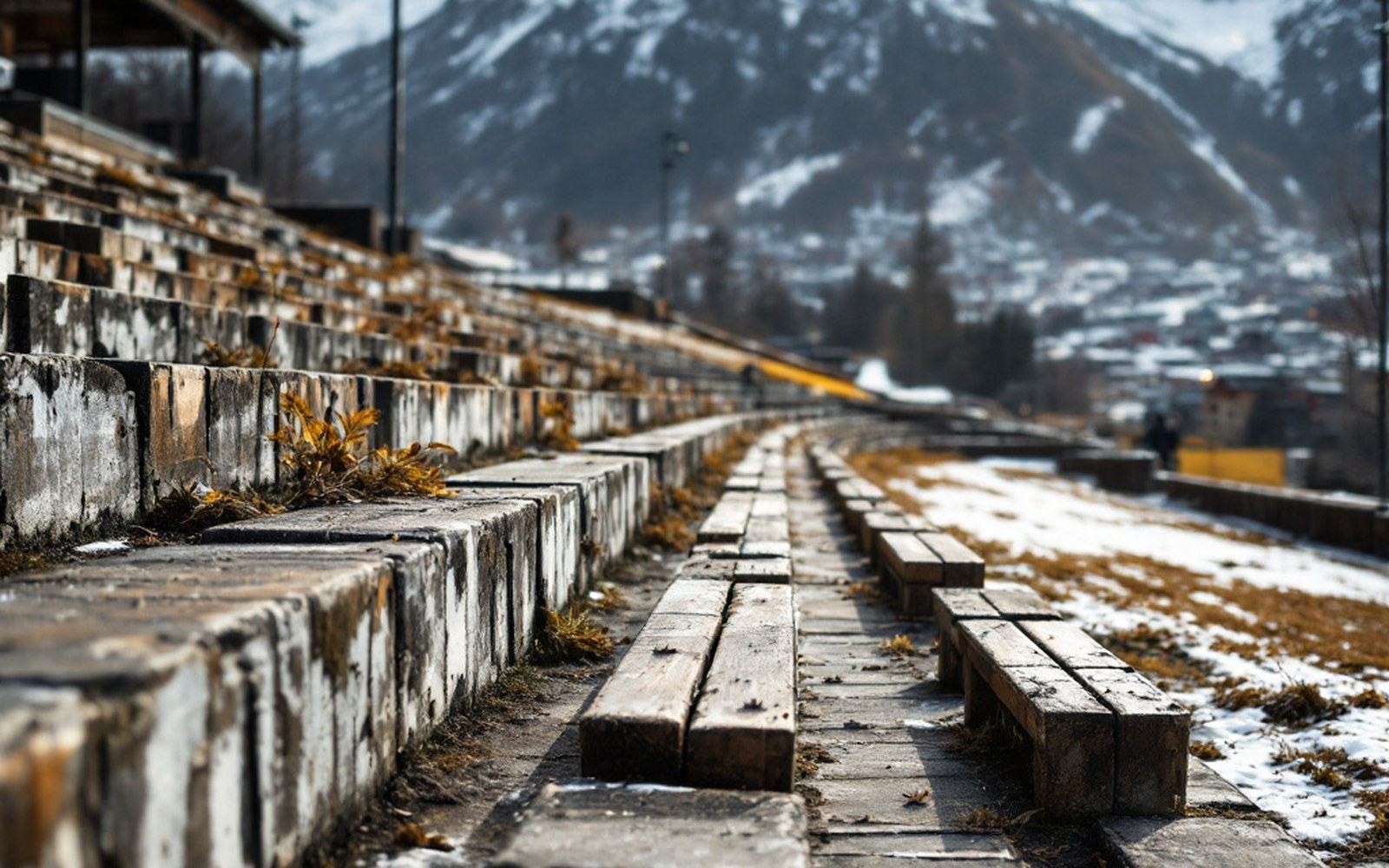
The stadium the Soviet era left behind
Nalchik is the capital of Kabardino-Balkaria, a republic in the central North Caucasus with a population measured in hundreds of thousands rather than millions. Its football stadium was built to that scale: a compact municipal ground set in a parkland belt on the city’s western side, where the Soviet-era design philosophy put sports facilities alongside sanatoria and tree-lined promenades. The ground was functional, civic and entirely adequate for the level of football the city was expected to produce.
The Spartak Stadium’s official capacity when Spartak Nalchik were playing in the Russian Premier League sat at around ten thousand. That figure placed it among the smallest grounds in the division throughout the club’s six seasons at the top level, from 2006 to 2012. The stands were largely uncovered, a characteristic inherited from the Soviet tradition of building football grounds as open terraces where the summer crowd could stand in warmth. In the North Caucasus, with its long, mild seasons, that logic held better than it would have in, say, Perm or Kazan, but it still left supporters exposed when October arrived and the Caucasus autumn turned sharp.

The running track around the pitch was a further Soviet inheritance. Multi-use athletics stadiums were the standard municipal template across the USSR: a football club used the central grass, and the wider community used the cinder or asphalt lanes. That design decision, sensible from a shared-infrastructure standpoint, placed the furthest rows of spectators a long way from the touchline. At a ten-thousand-capacity ground the distances were manageable but still present, and anyone seated on the back rows of the main stand was watching football at a distance that the ground’s modest size did not entirely justify.
What the Premier League years required and what was done
When Spartak Nalchik won promotion in 2005, the Premier League had minimum standards for top-flight grounds, and the Spartak Stadium met them — narrowly. Floodlights were upgraded. The media facilities, a press box and interview zones, were brought up to the requirements the league and broadcasters expected. These were improvements to the existing structure rather than reconstruction, and that distinction mattered: the club’s budget did not accommodate anything more ambitious.
The artificial pitch debate that ran through North Caucasus football during those years was particularly relevant at this ground. Natural grass in Nalchik is viable — the climate is kinder than in Siberia or the Urals — but maintaining a playing surface to top-flight standard through a full Russian season, with its demands of two matches a week at peak points of the calendar, is a different task from keeping a training pitch playable. The club used the Spartak Stadium as its main venue throughout, and the long winter break that the Russian calendar carries gave the groundstaff time to recover the surface between the autumn and spring halves of the season. That break — typically running from late November until early March — was the structural feature that made natural grass manageable at this latitude, and the Spartak Stadium was one of the grounds whose continued use of grass depended on it.
Crowd figures during the Premier League seasons fluctuated with the team’s fortunes. In the early years, when Spartak Nalchik’s survival in the division was itself a source of civic pride, the ground attracted near-capacity attendances for significant fixtures. The best season on the pitch, 2010, when the club finished sixth — a result that surprised most observers of Russian football — drew genuine support, and the stadium was animated in a way that a ground of its modest size can sustain: close, noisy, partisan without being large. When form declined and the relegation of 2012 became a financial as much as a sporting story, the crowds thinned accordingly.

The ground in its setting
The stadium sits inside a broader park zone that is one of the defining features of Nalchik as a city. The park was developed substantially in the Soviet period and is genuinely unusual in the Caucasus region: broad, shaded, threaded with paths and small waterways, with the Caucasus range — and on a clear day the specific mass of Mount Elbrus — visible to the south above the treeline. Nalchik’s park belt is sometimes cited as one of the better surviving examples of Soviet civic landscape design in the region.
This setting gave the Spartak Stadium a character that was not easily replicable by building. Approaching the ground through the park on a summer or early autumn matchday, with the mountains as a backdrop and the trees still in leaf, produced an atmosphere that photographs from that period capture reliably: a small, self-contained football occasion embedded in a specific place. The ground itself was not architecturally remarkable, but its location gave it more identity than a comparable stadium dropped into an industrial edge of the same city would have had.
The regional context sharpened that identity further. Matches against Alania Vladikavkaz, Anzhi Makhachkala or Terek Grozny carried a weight that had nothing to do with capacity, and the Spartak Stadium was the site where those fixtures, when they fell at home, were played out. A ground holding ten thousand people can produce an intense atmosphere when the crowd is full, unified and aware that the opposition carries a particular meaning. The North Caucasus derbies at the Spartak Stadium in the Premier League years had that quality.
What the ground never had, and was never rebuilt to have, was the infrastructure that sustained clubs with more money and longer top-flight histories. No significant upper tier was added, no roof covered the open sections, and the athletics track was never removed to bring supporters closer to the pitch. The stadium that Spartak Nalchik used for their six Premier League seasons was essentially the stadium they had inherited from the Soviet city league, maintained, licensed and pressed into service at a level its designers had not anticipated. That it held the club’s top-flight years without major incident is partly a testament to the durability of basic Soviet construction, and partly a record of what a well-run small club can achieve when the ambitions stay proportionate to the resources.